
IBM Power 11 Model S1112 9242-21B / 9242-21T ➤ Inside the Newest Power 11 Server and the Two AI Launches It Was Built to Support

How IBM's smallest Power 11 system yet ...model numbers 9242-21B (rack) and 9242-21T (tower) ...anchors IBM's push into autonomous IT and agentic IBM i development.
None of the three is really a standalone story. The 9242-21B/9242-21T is the machine IBM wants running the other two. Autonomous Operations and Bob are the software IBM wants proving out the machine. This article starts at the press-release level ...what IBM said, when, and why ...then works down into the specifics:
- The exact model numbers
- The difference between the 9242-21B rack build and the 9242-21T tower build
- The CPW and rPerf numbers by configuration
- How each piece fits into IBM's broader autonomous-IT and agentic-AI strategy for the Power platform
Part One | The Announcement, As IBM Made It
ARMONK, N.Y., July 15, 2026 ...IBM (NYSE: IBM) announced IBM Power Autonomous Operations, an AI agent that continuously monitors Power systems and can autonomously resolve issues to keep operations running smoothly. IBM positioned it as a companion to the recently launched IBM Bob Premium Package for i, and paired both software launches with new hardware: the entry-level Power S1112 (model numbers 9242-21B and 9242-21T), described in IBM's official announcement as compact and efficient enough to run AI inference locally, on-premises, without shipping data anywhere else.
IBM framed the announcement around a specific number. According to the IBM Institute for Business Value's 2026 Tech Leader Study, enterprises expect to deploy an average of 1,661 AI agents by 2027 ...a 38% increase over current levels. At that scale, IBM argues, manual IT governance simply runs out of road: tech leaders would be responsible for supervising hundreds of thousands of autonomous decisions a day. Hillery Hunter, General Manager for IBM Power and CTO of IBM Infrastructure, framed the trade-off IBM says it's trying to eliminate:
That's the thesis for all three launches: push routine operational and development labor onto AI agents, and let human teams spend their attention on things that actually require judgment.
Availability dates, as announced:
| Release | GA Date |
|---|---|
| IBM Bob Premium Package for i | June 24, 2026 (already generally available) |
| IBM Power S1112 (9242-21B / 9242-21T) | July 24, 2026 |
| IBM Power Autonomous Operations | September 23, 2026 |
Worth noting for planning purposes: Bob is live today, the 9242-21B/9242-21T becomes orderable in roughly a week from its announcement, and Autonomous Operations won't actually ship for about two months after the announcement. IBM is announcing the full vision before all three pieces exist in market ...a common enough practice, but it means the "self-operating Power platform" story is currently half-hardware, half-roadmap.
Part Two | The Hardware - IBM Power S1112 (Model 9242-21B / 9242-21T)
Why the 9242-21B Counts as "the newest Power11 model"
Power11 first launched July 8, 2025, with a full-range simultaneous rollout across entry, mid-range, and high-end systems:
- 9824-22A (S1122)
- 9824-42A (S1124)
- 9043-MRU (E1150)
- 9080-HEU (E1180)
- 9856-22H (L1122) (Linux-only)
- 9856-42H (L1124) (Linux-only)
That was IBM's initial Power11 wave. The 9242-21B is not part of that original wave. It's a follow-on model, announced a full year later, specifically to fill a slot none of the original Power11 machine types occupy: the IBM i P05 software tier.
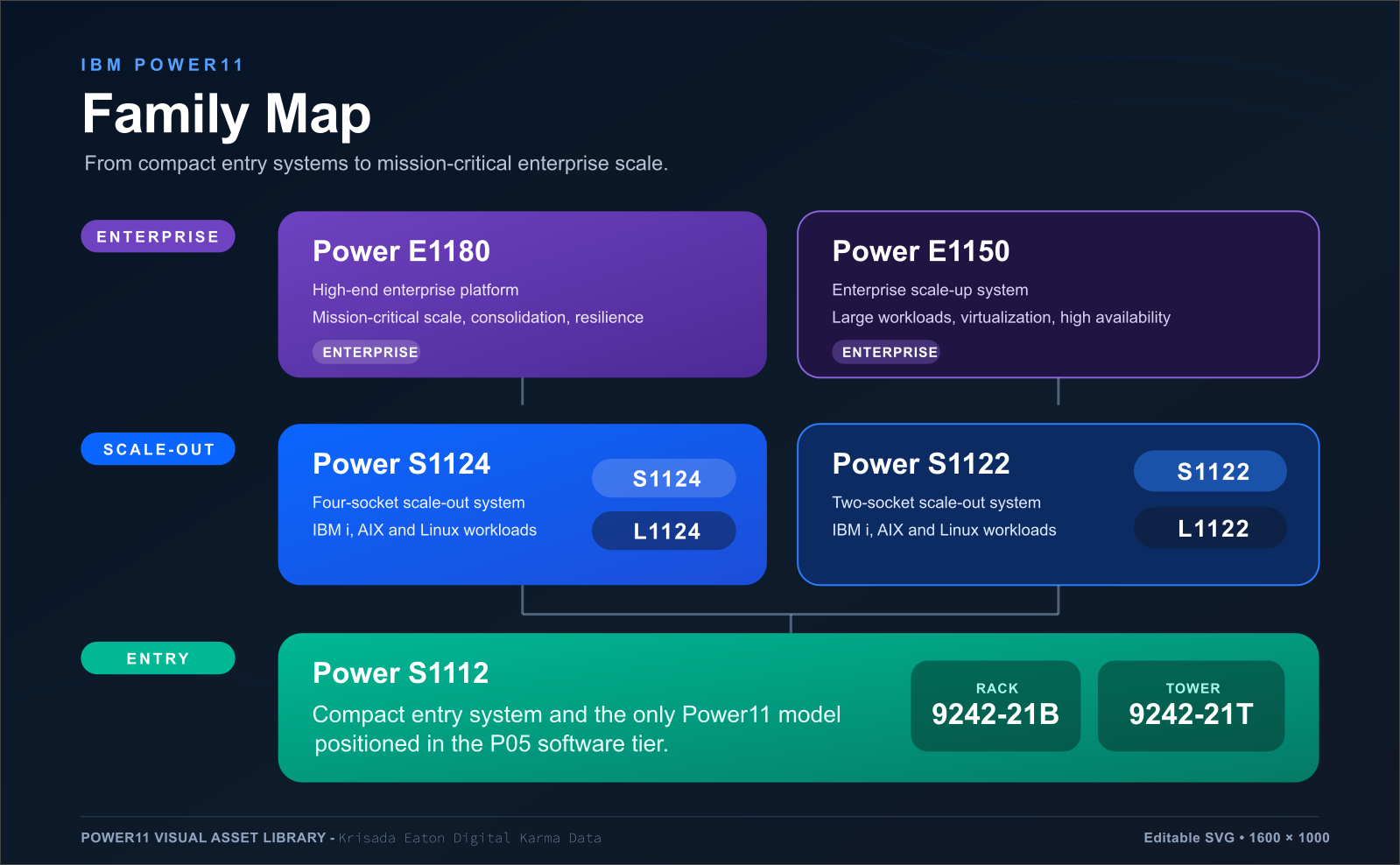
Every other Power11 system ...9824-22A, 9824-42A, 9043-MRU, 9080-HEU ...starts at P10 or higher. The 9242-21B (and its tower twin, the 9242-21T) is, as of this announcement, the only Power11 server available in the P05 tier, which matters directly to cost: IBM i software licensing and many independent software vendor (ISV) products price by software tier, and P05 is the lowest-cost tier IBM offers. For a small business or department running a handful of IBM i partitions, that tier placement is often the deciding factor in a hardware refresh, independent of raw performance.
Model Numbers: 9242-21B and 9242-21T
IBM ships the Power S1112 under two machine-type-model numbers, which map to physical chassis, not to performance:
- 9242-21B ...2U half-wide rack-mounted chassis
- 9242-21T ...free-standing tower chassis
If you're comparing quotes, spec sheets, or PTF/OS support pages, the model number is the identifier to search on ...9242-21B for the rack configuration, 9242-21T for the tower.
Vendors and IBM documentation alike key their pages off these machine-type-model strings rather than off "S1112" alone, since "S1112" is the marketing name shared by both chassis.
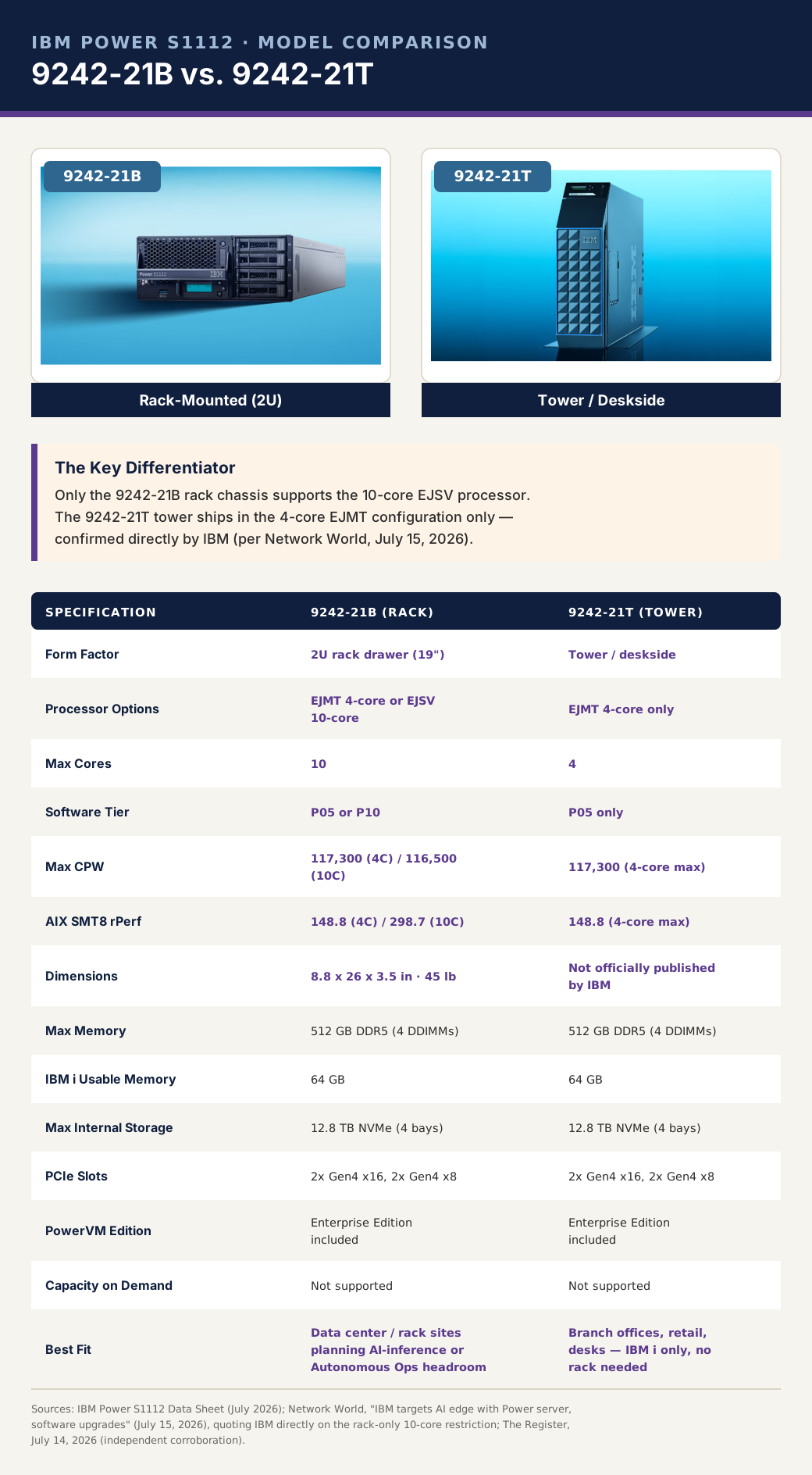
Both the 9242-21B and 9242-21T share identical internal specifications:
- Same processor options
- Same memory ceiling
- Same I/O
- Same performance figures
The choice between them is purely a facilities decision ...whether the target environment has rack space and standard data-center cooling/power (9242-21B), or whether it's a small office, remote site, or branch location where a free-standing tower (9242-21T) sitting on or under a desk makes more practical sense. IBM's own product photography for this launch featured both form factors side by side for exactly this reason: the 9242-21B/9242-21T pairing is explicitly being sold as flexible on physical deployment, unlike the rack-only 9824-22A (S1122) and 9824-42A (S1124).
Physical specifications (9242-21B rack configuration):
| Spec | Value |
|---|---|
| Width | 8.8 in (223.5 mm) |
| Depth | 26 in (660.4 mm) |
| Height | 3.5 in (88.9 mm) ...2U |
| Weight | 45 lb (20.4 kg) |
The Two Processor Configurations on 9242-21B / 9242-21T: EJMT (4-core) and EJSV (10-core)
Within both the 9242-21B and 9242-21T chassis, IBM offers two processor feature codes, and this is where the positioning gets more nuanced than "entry-level box."
9242-21B EJMT ...4-core, 3.6-4.0 GHz, P05 software tier
This is the processor that defines the 9242-21B as a P05 system.
It runs at 117,300 CPW (Commercial Processing Workload, IBM's relative-performance metric for IBM i) and posts rPerf figures of...
- ST: 39.9
- SMT2: 81.8
- SMT4: 119.9
- SMT8: 148.8
This is the configuration IBM is comparing against the aging Power S914 and S814 in its marketing claims ...2x better core performance than the S914, 3x better than the S814, per published CPW benchmarks IBM dated to July 14, 2026. The identical processor is available on the 9242-21T tower chassis with the same CPW and rPerf figures.
9242-21B EJSV ...10-core, 3.05-4.0 GHz, P10 software tier
Add six more cores and the same 9242-21B (or 9242-21T) chassis jumps software tiers entirely, up to P10, with CPW of 116,500 and rPerf of...
- ST: 95.4
- SMT2: 185.6
- SMT4: 247
- SMT8: 298.7
Notably, total CPW is roughly flat between the two 9242-21B configurations (117,300 vs. 116,500) ...the 10-core EJSV variant isn't meaningfully more powerful in aggregate IBM i throughput, it's more parallel, with far higher multi-thread rPerf. What actually changes is headroom for non-IBM-i workloads: AIX, Linux, and VIOS partitions can use the additional cores that IBM i workloads themselves are capped from using.
IBM's official announcement also published an energy-efficiency figure specific to the 10-core EJSV configuration: up to 69% better performance-per-watt than the Power S914. The footnoted basis is worth including because it's not a simple like-for-like comparison ...IBM extrapolated a 10-core CPW figure of 291,300E (from the 4-core EJSV rating of 116,500 CPW) running at 540E watts (539 performance/watt), against an 8-core Power S914 rated at 122,500 CPW running at 383 watts (319 performance/watt). The 539-to-319 ratio is where the "1.69x," or 69% figure, comes from. It's a legitimate calculation, but it's extrapolated and core-count-adjusted rather than a direct 4-core-to-4-core measurement, which is worth knowing if you're citing the number to a buyer.
That cap is the detail buyers most often miss.
Regardless of which processor option is installed on the 9242-21B or 9242-21T, IBM i workloads are limited to 4 virtual processors and 64 GB of main storage. IBM's own datasheet describes this as a "flexible 'virtual boundary' approach" ...organizations can allocate unused processor cores and memory to AIX and Linux workloads running alongside IBM i on the same system, without affecting IBM i's P05 software tier eligibility. If you buy the 10-core EJSV expecting IBM i to use all ten cores, it won't ...the extra six cores exist to host AIX, Linux, or VIOS workloads alongside your IBM i partitions, not to make IBM i itself faster. This is by design: it's what lets a single 9242-21B (or 9242-21T) serve as a genuine multi-OS consolidation platform for a small business, running an ERP system on IBM i in one partition while a Linux-based web front end or AI inference workload runs in another, on the same machine.
One correction worth flagging against our earlier draft: we'd stated the system caps out at "four IBM i partitions." IBM's official datasheet doesn't state that figure directly ...it's a reasonable practical inference (4 virtual processors, minimum 1 per partition), but the number IBM actually publishes is a system-wide maximum of 200 logical partitions/micropartitions across all operating systems combined (IBM i, AIX, and Linux together), under PowerVM Enterprise Edition, which is included standard on the 9242-21B/9242-21T. We're correcting that rather than repeating the inferred figure as an IBM-stated fact.
9242-21B / 9242-21T Reliability, Availability, and Serviceability (RAS)
IBM's datasheet lists a specific RAS feature set for the 9242-21B/9242-21T, worth including since reliability is a large part of the buying decision at this tier:
| RAS Feature | Supported |
|---|---|
| Chipkill memory protection | Yes |
| Service processor (eBMC) | Yes |
| Hot-swappable NVMe SSD disks | Yes |
| Dynamic processor deallocation | Yes |
| Processor instruction retry | Yes |
| Hot-plug concurrent maintenance for PCIe slots | No |
| Redundant hot-plug power | Yes |
| Redundant hot-plug cooling | Yes |
| Dual VIOS support | Yes |
| Active Memory Mirroring | Yes |
| Capacity on Demand (CoD) | No |
| Power Private Cloud (EP2.0) | No |
| PowerVM Enterprise Edition | Included |
| External NVMe expansion drawer support | Not supported (0 slots) |
Two of these are worth calling out specifically for buyers evaluating against higher Power11 tiers. First, PCIe slots on the 9242-21B/9242-21T are not hot-plug capable ...adding or replacing an adapter requires a scheduled maintenance window, unlike higher-tier Power11 systems. Second, and more significant for growth planning: the 9242-21B/9242-21T does not support Capacity on Demand. Higher Power11 models let you activate additional cores or memory on demand as workloads grow, without a physical hardware change; the entry-tier S1112 doesn't offer that flexibility, so capacity planning needs to account for the actual ceiling (4 or 10 cores, 512 GB max memory) at time of purchase rather than assuming elastic on-demand growth later.
9242-21B / 9242-21T Memory, Storage, and I/O
| Spec | Value |
|---|---|
| Max memory | 512 GB DDR5 (4 DDIMM slots) |
| Max memory usable by IBM i | 64 GB |
| Memory speed | 4000-4800 MHz, 16Gbit DDR5 DDIMM |
| Max internal storage | 12.8 TB NVMe U.2 (4 slots) |
| Max storage for IBM i (after mirroring) | 6.4 TB |
| PCIe slots | 4 total ...two Gen4 x16, two Gen4 x8 (non-hot-plug) |
| Optional expansion | ENZ0 PCIe Gen4 I/O Expansion Drawer (adds 6 more PCIe Gen4 slots) |
| Management | Enterprise Baseboard Management Controller (eBMC), 1 GbE HMC port |
| Power | Redundant hot-swap AC Titanium-rated supplies |
Compared to the closest Power10 equivalent, the 4-core 9028-21B (S1012), the generational gain on the 9242-21B is real but not dramatic on raw CPW ...about 5.4% more (117,300 vs. 111,300). Where the 9242-21B pulls ahead more clearly is usable memory: the 9028-21B loses IBM i memory to firmware overhead and tops out around 50 GB usable, while the 9242-21B delivers the full 64 GB, a 28% increase in effective capacity at the same nominal ceiling. Memory bandwidth is also up roughly 25%. For a shop running an aging 9009-41A/41G (S914, Power9) rather than a recent 9028-21B (S1012, Power10), the jump is much larger ...IBM's own figures put the 9242-21B at more than double the CPW per core of the S914's EP50 processor.
9242-21B / 9242-21T Operating System Support
- IBM i: 7.6 TR2, 7.5 TR8, 7.4 TR12 (with additional PTFs) ...native or as a VIOS client
- AIX: Version 7.3 (multiple technology levels) or 7.2 TL05, with appropriate service packs
- Linux: Red Hat Enterprise Linux 9.6 or 10.2 for Power LE, Red Hat OpenShift Container Platform 4.22+, SUSE Linux Enterprise Server 15 SP7 or 16
- VIOS: 4.1.1.30 or 4.1.2.10
Part Three | Defining IBM Power Autonomous Operations
IBM Power Autonomous Operations is an embedded AI agent, layered across the Power environment ...including systems like the 9242-21B and 9242-21T ...designed to continuously monitor system health and capacity, and to resolve routine operational issues ...primarily capacity constraints ...without a human manually working through dashboards, exported data, and remediation steps.
IBM's own benchmark for this is specific and disclosed in the announcement's footnotes: in a controlled test across eleven IBM Power systems, the manual process involved:
- Navigating to each system's performance dashboard
- Exporting data to CSV/XLS
- Analyzing it to identify needed capacity adjustments
- Implementing the changes
That process took an average of 52.59 minutes to detect and resolve a capacity-related condition. IBM Power Autonomous Operations, running alert ingestion plus AI-driven diagnostic analysis with human-in-the-loop approval before remediation, completed the equivalent process in an average of 3.33 minutes. That's the origin of IBM's headline "15x faster" claim, and it's worth noting explicitly what it does and doesn't cover: it's a capacity-constraint detection-and-resolution benchmark, not a general claim about all operational tasks, and remediation still requires a human to approve the action ...this is agent-assisted operations, not fully unattended infrastructure management.
The interaction model is conversational: teams manage, tune, and troubleshoot the Power environment through natural-language prompts rather than working exclusively through the Hardware Management Console or performance-monitoring GUIs. IBM's stated goal is to lower the floor of expertise required to keep a Power environment healthy ...letting generalist IT staff at smaller shops running a 9242-21B or 9242-21T handle tasks that previously required deep Power-specific domain knowledge.
IBM Power Autonomous Operations is expected to reach general availability on September 23, 2026.
Part Four | Defining IBM Bob Premium Package for i
IBM Bob is IBM's agentic AI development assistant, and the Premium Package for i is the edition purpose-built for IBM i application development and modernization ...specifically targeting the RPG-heavy codebases that make up the backbone of most IBM i shops, including many now migrating to the 9242-21B/9242-21T.
The problem IBM Bob is aimed at is a real and well-documented one in the IBM i world: a large share of production RPG applications were written decades ago, often by developers who have since retired, and modernizing or even safely modifying that code requires specialized skills that are increasingly scarce in the labor market. IBM Bob is designed to compress that expertise gap. It offers what IBM describes as an "agentic SDLC experience" ...support across the full software development lifecycle, not just code generation ...including:
- Reading and interpreting legacy RPG logic
- Tracing field- and data-level dependencies through old programs
- Generating documentation for code that was never documented
- Helping engineers make changes with more confidence about what else in the system a change might touch
The results IBM is citing come from an early adopter, Heartland Co-Op, which modernized grain-operations applications using IBM i and IBM Bob together and reported an estimated 60% faster ramp-up time for developers who are new to the platform, when it comes to understanding complex existing applications. In the announcement, additional practitioner feedback echoed the same theme from a different angle: Bob Richardson, an ERP Support Analyst at Wynne Systems, specifically praised the depth of Bob's project planning relative to other AI tools he'd used ..."given the exact same prompt, Bob's planning was always 10-fold more detailed than other AIs."
IBM Bob Premium Package for i reached general availability on June 24, 2026 ...it's the only one of the three July 15 announcements already shipping.
Client Momentum: What Early Adopters Are Saying
IBM's official announcement included several client and partner quotes worth folding in, since two of them speak directly to the hardware/software connection this article is built around.
Jasmine Kaczmarek, VP of Technology at M.R. Williams, credited IBM Power and IBM i for the operational stability her business depends on, and specifically pointed to the S1112's combination of added capacity, energy efficiency, and easier management as what excites her about the new hardware. She separately described IBM Bob as a way for her team to speed up modernization work ...interpreting older RPG code, tracing field-level logic, and generating documentation ...turning years of accumulated system knowledge into something more usable.
Andy Buchholtz, Owner of Innovative Software Solutions, framed the S1112 specifically around the multi-OS consolidation angle covered in Part Five above: the ability to run Linux partitions for new AI workloads alongside an existing IBM i environment on the same box, without giving up the reliability of the Power platform.
Bob Richardson, ERP Support Analyst at Wynne Systems, is the source of the "10-fold more detailed" comparison already cited above ...he specifically contrasted Bob's project-planning depth against other AI tools given identical prompts.
A fourth quote, from Chad Simpson, CIO at City Home, speaks to Power's broader ecosystem rather than the S1112 specifically ...he described quarterly disaster-recovery role-swap testing built on IBM Cloud and Power Virtual Server, IBM's managed cloud offering for AIX, IBM i, and Linux workloads. It's included in IBM's release as evidence of Power platform momentum generally, not as a comment on this hardware launch, so we're noting it here for completeness rather than treating it as S1112-specific validation.
Part Five | How the 9242-21B and 9242-21T Configurations Actually Serve the Two Software Launches
This is the part of the announcement IBM's press release gestures at but doesn't spell out mechanically, so it's worth being explicit about how the hardware and software choices connect.
The 9242-21B/9242-21T EJMT configuration (4-core) is the IBM Bob / IBM i modernization play
Because IBM i workloads on the 9242-21B and 9242-21T are capped at 4 virtual processors and 64 GB regardless of which processor is installed, the 4-core EJMT configuration delivers essentially all of the IBM i capacity either chassis can offer, at the lowest possible cost (P05 tier licensing). This is the natural landing spot for a small or mid-sized IBM i shop that wants to:
- Get onto Power11 ...via the 9242-21B rack or 9242-21T tower ...without an enterprise-scale hardware and licensing bill, and
- Start using IBM Bob to accelerate modernization of an existing RPG codebase.
In other words: the 9242-21B/9242-21T EJMT configuration is sized around keeping the IBM i estate running efficiently while Bob does the work of making that estate more maintainable ...not around adding capacity for new workloads. It's a "shore up what you have" configuration.
The 9242-21B/9242-21T EJSV configuration (10-core) is the Autonomous Operations / local-AI-inference play
The 10-core EJSV configuration of the 9242-21B or 9242-21T doesn't meaningfully add IBM i throughput (again, IBM i is capped either way), but it does add six cores' worth of headroom for AIX, Linux, or VIOS partitions running alongside IBM i. That headroom is exactly where IBM's "AI inference at the edge" pitch for the 9242-21B/9242-21T lives ...a Linux partition using Power11's on-chip Matrix Math Acceleration (MMA) to run inference workloads locally, at a branch or remote site, without shipping data back to a central data center. It's also the more natural target for IBM Power Autonomous Operations: a system running multiple concurrent partitions and mixed workloads is exactly the kind of environment where capacity constraints emerge unpredictably across partitions, which is the specific problem Autonomous Operations is built to detect and resolve.
So the practical framing is: 9242-21B/9242-21T EJMT (4-core) pairs with Bob to modernize what you already have; 9242-21B/9242-21T EJSV (10-core) pairs with Autonomous Operations and on-chip AI inference to run more, and more varied, workloads on the same machine while an agent handles the operational overhead of doing so. Many buyers will land on the 10-core option even for primarily-IBM-i shops, simply to reserve that headroom for a future Linux-based AI or automation workload ...the incremental hardware cost of six more cores is often smaller than the cost of a second physical system later.
IBM Power Expert Care Premium Essentials for the 9242-21B / 9242-21T
IBM paired the 9242-21B/9242-21T launch with a new support tier ...Power Expert Care Premium Essentials ...available exclusively for this model. It's incident-focused, offering priority access to IBM specialists, faster response times, and automated support tooling. Its
exclusivity to the 9242-21B and 9242-21T signals that IBM expects these systems to land in environments ...small businesses, branch
offices, edge sites ...that don't have dedicated Power-specialist IT staff on hand, and therefore need faster, more automated vendor-side support when something does go wrong.
Part Six | Why the 9242-21B / 9242-21T Matters to IBM
Power has long been IBM's platform for workloads businesses genuinely cannot afford to lose ...core banking, ERP, healthcare records, manufacturing and distribution systems. That reputation is an asset, but it's also a constraint: Power's growth has historically been throttled by the size and specialization of the market willing to buy enterprise-tier Power hardware.
The 9242-21B/9242-21T, at P05 pricing with a form factor a branch office can actually house, is IBM extending that same reliability story downmarket to businesses and departments that were previously priced or scaled out of the platform.
Layered on top of that market-expansion move is IBM's bigger strategic bet: that the next phase of enterprise IT is agentic, and that the winners will be the platforms that can absorb hundreds of thousands of autonomous AI decisions a day without a proportional increase in human oversight headcount.
IBM's own research is doing a lot of the argumentative work here ...the 1,661-agents-by-2027 figure, the 38% growth rate, the explicit claim that "manual governance can't keep up with that math."
Whether or not those figures hold up as forecasts, they're the premise IBM is building Power's product roadmap around: infrastructure that runs and tunes itself (Autonomous Operations), applications that get built and modernized with AI assistance (Bob), and hardware compact and efficient enough to put inference physically close to the data it's reasoning about (the 9242-21B/9242-21T's on-chip MMA).
There's also a quieter competitive angle.
IBM i and AIX shops are an aging, shrinking, but extremely loyal and high-retention customer base, and the single biggest long-term risk to that base isn't a competing platform ...it's attrition of the specialized human expertise required to keep decades-old RPG applications running.
IBM Bob is a direct hedge against that risk: if AI can meaningfully lower the skill floor required to safely modify legacy RPG, IBM protects decades of installed-base revenue that would otherwise erode as specialist developers retire.
Part Seven | Why the 9242-21B / 9242-21T Matters to Businesses and IT Buyers
For an organization currently running an aging Power8 or Power9 system ...or even an early Power10 9028-21B (S1012) ...the practical case for the 9242-21B (rack) or 9242-21T (tower) rests on a few concrete points rather than the AI narrative alone:
- Lower cost of entry to Power11. P05 licensing is the least expensive IBM i software tier, and the 9242-21B/9242-21T is currently the only Power11 model available in it.
- No forced application rewrite. Existing IBM i, AIX, and Linux applications continue running as-is; the hardware and OS-level upgrade doesn't require re-platforming.
- Real, if modest, performance and memory gains over Power10-generation entry systems, and substantial gains (2-3x core performance) over Power8/Power9-era systems many small businesses are still running.
- A genuine multi-OS consolidation option, particularly on the 10-core EJSV configuration, letting a single 9242-21B or 9242-21T host IBM i alongside Linux- or AIX-based workloads instead of running separate physical servers.
- A concrete AI on-ramp ...on-chip MMA acceleration for local inference ...that doesn't require a separate GPU investment or moving sensitive business data off-premises to use.
- A support model (Premium Essentials) built for shops without in-house Power specialists, which matters more at this end of the market than at the enterprise end.
The honest caveat: buyers should not expect the 9242-21B/9242-21T 10-core EJSV to make IBM i itself dramatically faster than the 4-core EJMT ...the IBM i cap is identical either way.
The decision between the two configurations should be driven by whether there's a near-term plan to run non-IBM-i workloads (AI inference, Linux services, VIOS) on the same machine, not by a belief that more cores means more IBM i throughput.
And for shops evaluating IBM Power Autonomous Operations and IBM Bob specifically: both are still young.
Bob has one publicly cited case study (Heartland Co-Op) and a handful of practitioner quotes; Autonomous Operations won't even be generally available until September 23, 2026, and its headline "15x faster" figure is drawn from a single internal benchmark scenario (capacity-constraint detection and resolution) rather than a broad claim across all operational tasks. Both are reasonable bets for organizations already committed to the Power platform, but neither has the multi-year independent track record that IBM i itself has.
Part Eight | How the 9242-21B / 9242-21T Compares Across Every Prior P05-Tier Generation
Our original comparison covered the 9242-21B against the Power10 S1012 (9028-21B), the Power9 S914 (9009-41A/41G), and the Power8 S814 (8286-41A). It left out one system: the Power10 S1014 (9105-41B), which was also a P05-tier machine and, for many shops, the more recent ...and more relevant ...upgrade baseline.
Midland's own technical comparison page (credited to Rob, Midland's longtime IBM Software Solutions Manager) fills that gap with full generational data. Here's the fuller picture, corrected and expanded.
CPW: Total and Per-Core, All Five P05-Tier Systems
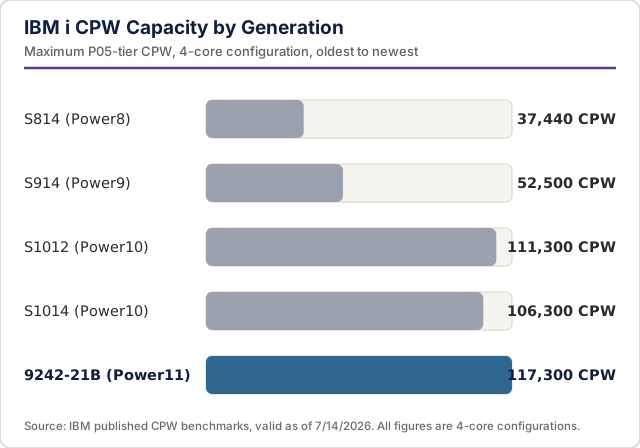
| System | Machine type / model | Processor | CPW per core | Max P05 CPW | vs. 9242-21B |
|---|---|---|---|---|---|
| Power11 S1112 | 9242-21B | EJMT, 4-core, 3.6-4.0 GHz | 29,325 | 117,300 | Baseline |
| Power10 S1014 | 9105-41B | EPG0, 4-core, 3.0-3.9 GHz | 26,575 | 106,300 | 9242-21B is 10.3% higher |
| Power10 S1012 (4-core) | 9028-21B | EPG7, 4-core, 3.0-3.9 GHz | 27,825 | 111,300 | 9242-21B is 5.4% higher |
| Power10 S1012 (1-core) | 9028-21B | EPG3, 1-core, 3.0-3.9 GHz | 29,000 | 29,000 | 9242-21B is 1.1% higher per core |
| Power9 S914 | 9009-41A/41G | EP50, 4-core, 2.3-3.8 GHz | 13,125 | 52,500 | 9242-21B is 123.4% higher |
| Power8 S814 | 8286-41A | EPXK, 4-core, 3.02 GHz | 9,360 | 37,440 | 9242-21B is 213.2% higher |
The one-core S1012 comparison is the one worth calling out specifically, because it changes the story on generational architecture. Per active core, a single-core S1012 (29,000 CPW) is nearly identical to a 9242-21B core (29,325 CPW) ...a gap of only about 1.1%. The 9242-21B's large advantage over a four-core S1012 (5.4%) and its enormous advantage over a one-core S1012 (over 300% in total capacity) is mostly a core-count story, not a per-core architecture leap. If you're licensed or budgeting by core, that distinction matters more than the headline CPW numbers suggest.
Memory Bandwidth: A Bigger Gap Than CPW Alone Suggests
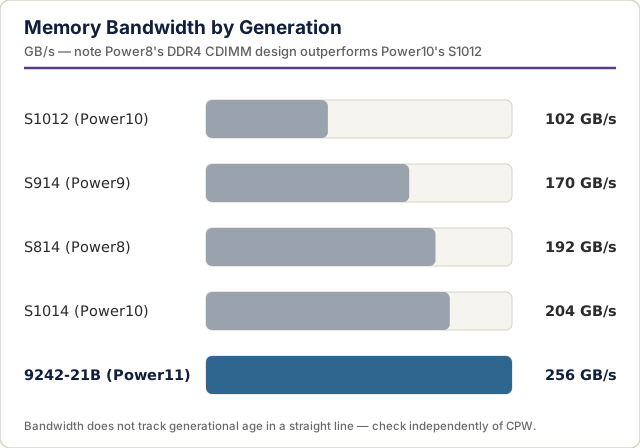
| System | Memory bandwidth | vs. 9242-21B |
|---|---|---|
| Power11 S1112 (9242-21B/9242-21T) | 256 GB/s | Baseline |
| Power10 S1014 | 204 GB/s | 9242-21B is 25.5% higher |
| Power10 S1012 | 102 GB/s | 9242-21B is 151% higher |
| Power9 S914 | 170 GB/s | 9242-21B is 50.6% higher |
| Power8 S814 | 192 GB/s | 9242-21B is 33.3% higher |
One counterintuitive detail here: the eight-year-old Power8 S814 (192 GB/s) actually has higher memory bandwidth than the more recent Power10 S1012 (102 GB/s), a product of DDR4 CDIMM vs. ISDIMM design choices on those two systems rather than a straight generational progression. Memory bandwidth doesn't move in a clean line across generations the way CPW does ...it's worth checking independently of "how new is the system," especially for Db2 for i-heavy or batch-heavy workloads where bandwidth, not just core CPW, drives throughput.
Storage: The 9242-21B's Advantage
Depends Entirely on What You're Replacing
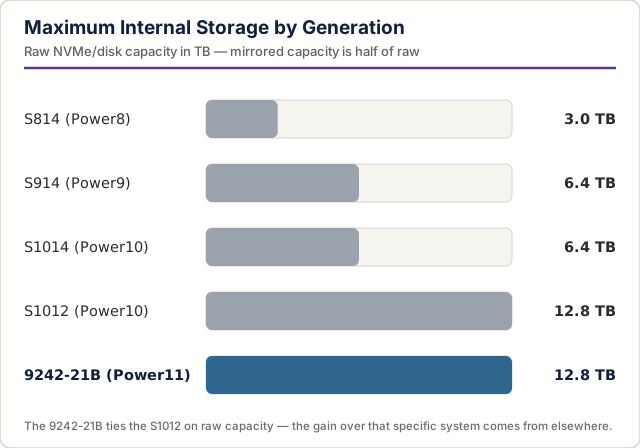
| System | Max internal IBM i storage | vs. 9242-21B |
|---|---|---|
| Power11 S1112 (9242-21B/9242-21T) | 12.8 TB raw / 6.4 TB mirrored | Baseline |
| Power10 S1014 | 6.4 TB raw / 3.2 TB mirrored | 9242-21B provides 2x the capacity |
| Power10 S1012 | 12.8 TB raw / 6.4 TB mirrored | Equal |
| Power9 S914 | 6.4 TB raw / 3.2 TB mirrored | 9242-21B provides 2x the capacity |
| Power8 S814 | 3 TB | 9242-21B provides ~4.27x the capacity |
If you're replacing an S1012, internal storage capacity doesn't change at all ...the gain has to come from elsewhere (bandwidth, usable memory, I/O drawer support). If you're coming from an S1014 or S914, capacity doubles. From an S814, it's more than a fourfold increase.
PCIe Slots: The One Place the 9242-21B Doesn't Win
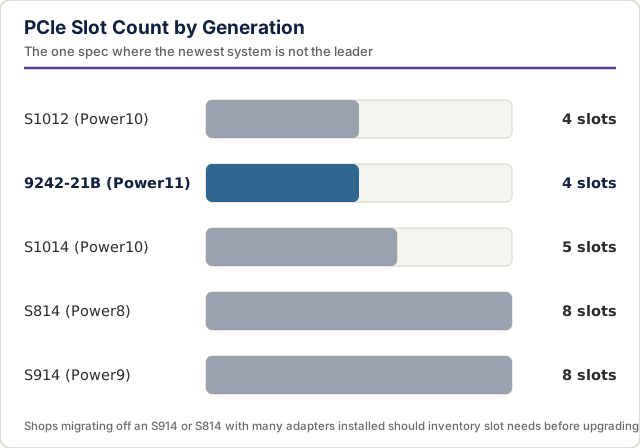
| System | Maximum PCIe slots |
|---|---|
| Power9 S914 | 8 (3x Gen4 x16, 5x Gen4 x8) |
| Power8 S814 | 8 listed (2x x16, 5x x8 specifically enumerated) |
| Power10 S1014 | 5 (mixed Gen4/Gen5) |
| Power11 S1112 (9242-21B/9242-21T) | 4 (2x Gen4 x16, 2x Gen4 x8) |
| Power10 S1012 | 4 (2x Gen4 x16, 2x Gen4 x8), no external I/O drawer support |
This is the one spec where newer isn't better: the S1014 has one more PCIe slot than the 9242-21B, and both the S914 and S814 have double. Shops with a lot of network, Fibre Channel, SAS, or tape adapters ...particularly those migrating off an S914 or S814 ...should inventory existing adapter counts before assuming a straightforward upgrade path onto the 9242-21B. The half I/O drawer option helps close the gap but is an added component, not a built-in slot.
A Note on the "64 GB Usable" Memory Claim
Quick Reference: Full IBM Power S1112 (9242-21B / 9242-21T) Specification Summary
| Category | Detail |
|---|---|
| Model numbers | 9242-21B (rack), 9242-21T (tower) |
| Marketing name | IBM Power S1112 |
| Sockets | 1 (single-socket, entry scale-out) |
| Processor options | EJMT 4-core (3.6-4.0 GHz, P05 tier); EJSV 10-core (3.05-4.0 GHz, P10 tier) |
| CPW | 117,300 (EJMT) / 116,500 (EJSV) |
| rPerf (EJMT) | ST 39.9, SMT2 81.8, SMT4 119.9, SMT8 148.8 |
| rPerf (EJSV) | ST 95.4, SMT2 185.6, SMT4 247, SMT8 298.7 |
| Max memory | 512 GB DDR5 (4 DDIMM slots, 4000-4800 MHz) |
| IBM i usable memory | 64 GB (capped regardless of processor option) |
| IBM i partitions | Not separately capped by IBM; system-wide max is 200 logical partitions/micropartitions (all OSes combined) |
| Max internal storage | 12.8 TB NVMe U.2 (6.4 TB after mirroring for IBM i) |
| PCIe slots | 4 (2x Gen4 x16, 2x Gen4 x8), non-hot-plug |
| Optional I/O expansion | ENZ0 drawer, +6 PCIe Gen4 slots |
| Chassis (9242-21B, rack) | 2U, half-wide, 8.8 x 26 x 3.5 in, 45 lb |
| Chassis (9242-21T, tower) | Free-standing tower, same internal specs as 9242-21B |
| Software tier | P05 (only Power11 machine type in this tier) |
| GA date | July 24, 2026 |
| Exclusive support tier | IBM Power Expert Care Premium Essentials |
| Capacity on Demand | Not supported |
| PowerVM edition included | PowerVM Enterprise Edition |
Part Ten | IBM Power S1112 Datasheet Download and Highlights
If you want IBM's own short-form overview of the platform, the official July 2026 datasheet gives the fastest summary of how IBM is positioning the Power S1112 for IBM i, AIX, and Linux buyers.
Short take: IBM presents the Power S1112 as an entry-level Power11 server for smaller core workloads, branch offices, remote locations, and edge environments that need modern Power11 performance, strong security, AI-ready acceleration, and flexible mixed-workload support in either a compact rack or tower form factor.
- Entry-level Power11 positioning. IBM frames the S1112 as a one-socket Power11 system for IBM i, AIX, and Linux in compact and distributed environments.
- Performance story. The datasheet highlights up to 2X better core performance versus the Power S914 and 3X better core performance versus the Power S814.
- Memory and storage ceiling. Up to 512 GB of DDR5 memory and up to 12.8 TB of internal NVMe U.2 storage are called out as the main local resource limits.
- IBM i virtual boundary. IBM emphasizes support for up to 4 IBM i cores and 64 GB for IBM i workloads while unused resources can be allocated to AIX or Linux partitions on the same server.
- Security and resilience. The datasheet calls out built-in quantum-safe security, enterprise RAS features, redundant hot-plug power and cooling, Chipkill memory, and PowerVM Enterprise Edition support.
- AI and edge use cases. IBM specifically positions the S1112 for near-edge inferencing, local analytics, automation, and data-local processing where latency and governance matter.
- Partitioning headroom. The spec table confirms a system-wide maximum of 200 logical partitions or micropartitions, even though Capacity on Demand is not supported on this model.
Download the IBM Power S1112 9242-21B / 9242-21T Datasheet PDF
IBM Power S1112 Data Sheet, 5 pages, July 2026.